

How to Create Emergency Towing Content That AI Can Easily Understand
Sep 21, 2026


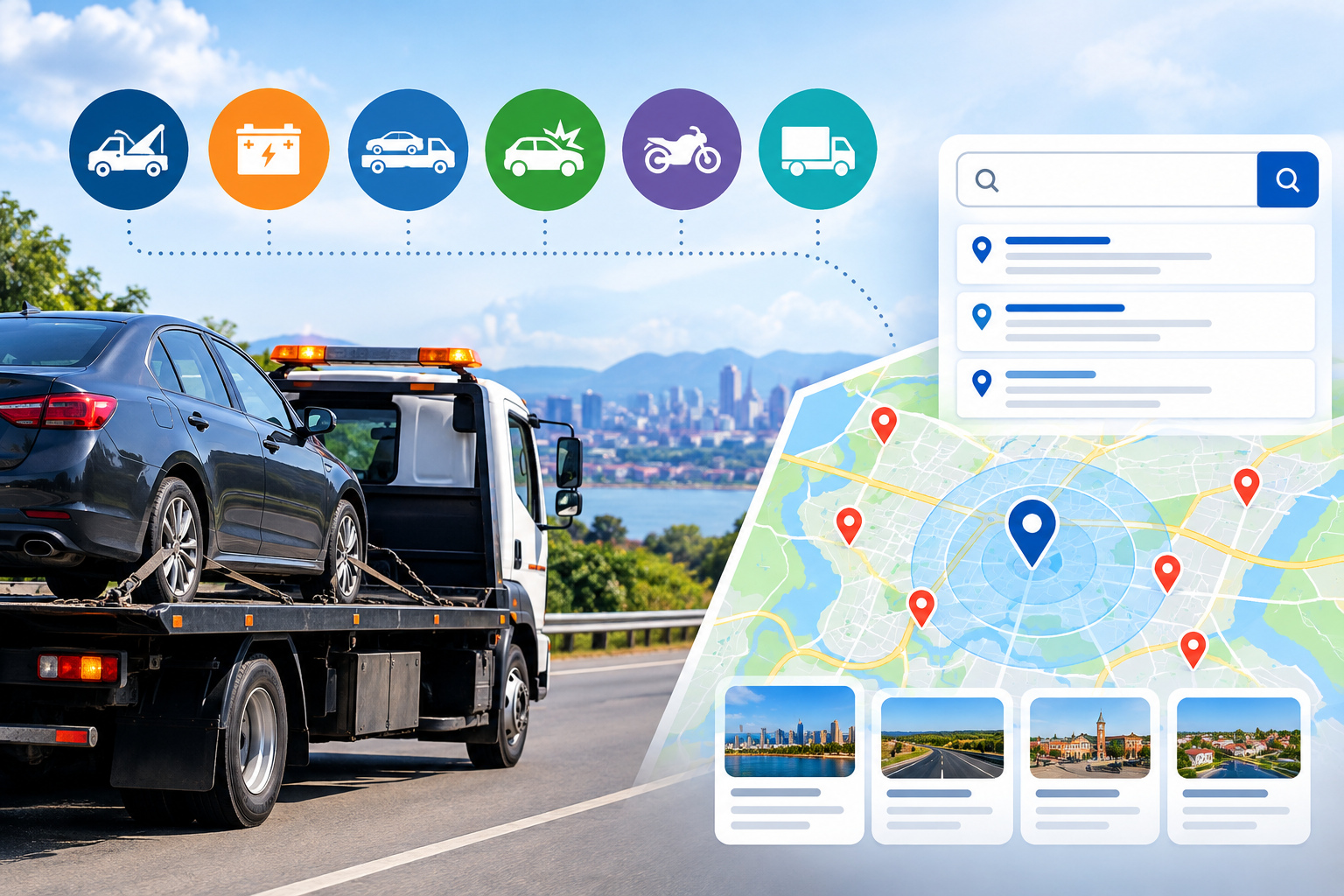
Your service area is more than a list of cities on a towing website. Each location can represent a specific search opportunity when you build useful, locally relevant content around what customers actually need. With the right strategy, your local coverage can become a network of search assets that supports organic visibility, qualified traffic, and more towing leads.
However, simply creating dozens of city pages is not enough. Google warns against doorway pages created primarily to capture similar location-based searches without providing meaningful value. Your goal should be to make every important service-area page genuinely useful to the people you serve.
Start by documenting the areas where you genuinely provide towing services. Separate your coverage into cities, neighborhoods, communities, highways, and surrounding areas where appropriate.
Then connect each location to relevant services, such as:
This creates a clear relationship between service + location + customer intent.
Instead of targeting every location imaginable, prioritize areas where your towing company actually operates and where customers are likely to search for assistance.
A strong service-area page should answer the questions a customer has about getting help in that specific location.
For example, someone searching for towing in a particular city may want to know:
Your content should address these questions naturally instead of repeating the city name throughout every paragraph.
Local relevance becomes stronger when your pages contain information that actually helps someone in that area.
You can discuss major roads, common driving situations, nearby communities, local service zones, parking challenges, weather-related towing needs, or typical roadside problems.
For example, an emergency towing page could explain what drivers should do after a breakdown on a busy highway serving that area.
The objective is not to insert random landmarks for SEO. It is to demonstrate why your service is relevant to customers in that location.
Your local pages should not exist as isolated URLs.
Create a logical internal-linking structure between your main towing services, location pages, emergency resources, FAQs, and supporting blog content.
For example, an emergency towing article can link to a relevant service-area page. That page can link back to emergency towing services and related roadside assistance content.
This creates a contextual network that helps search engines understand the relationships between your services and geographic coverage.
A well-structured website also makes it easier for visitors to move from information to action.
Think beyond the traditional idea of a “city page.”
A valuable search asset can be:
These assets can address different stages of the customer journey.
Someone may search for what to do after a breakdown before they are ready to hire a towing company. Helpful content allows your business to become visible earlier in that journey.
Avoid producing the same page repeatedly and changing only the city name.
Google’s spam policies specifically identify substantially similar location pages created to capture similar queries as a potential doorway-abuse problem.
Instead, give each valuable location page a distinct purpose. Include relevant services, genuine coverage information, local customer concerns, useful FAQs, and clear next steps.
Quality should determine how many pages you create—not the number of locations you can put into a spreadsheet.
Your local content should naturally connect related concepts.
For towing, those concepts may include:
vehicle breakdown → roadside assistance → emergency towing → vehicle recovery → service area → dispatch → towing equipment → customer safety
These relationships give search engines and AI systems more context about your expertise.
A Towing SEO Company can help organize these relationships into a scalable content architecture that supports both traditional search and emerging AI-driven discovery.
Search visibility matters most when it leads somewhere useful.
Place relevant calls to action throughout your service-area content without making every section sales-focused. A customer reading about emergency towing should have an obvious way to request help.
You can use a concise CTA such as:
Need Towing Help?
Get Local Towing Support
For businesses ready to strengthen their local search strategy, Contact us today to discuss a more focused towing SEO approach.
They are useful website pages and resources designed around genuine service locations and customer search needs.
Not necessarily. Create separate pages when they provide meaningful, location-specific value rather than simply repeating the same content.
It connects location, service, search intent, internal links, useful content, and relevant local signals into a structured website strategy.
Include the services offered, genuine coverage details, local customer needs, helpful information, FAQs, internal links, and a clear conversion path.
Yes. Clearly structured, context-rich content can make your services, locations, and relationships easier for search systems and AI-powered experiences to interpret.
Focus on real service coverage and unique user value. Do not create pages simply by replacing one city name with another.