

How to Build a Towing Website AI Search Engines Can Understand
Aug 31, 2026


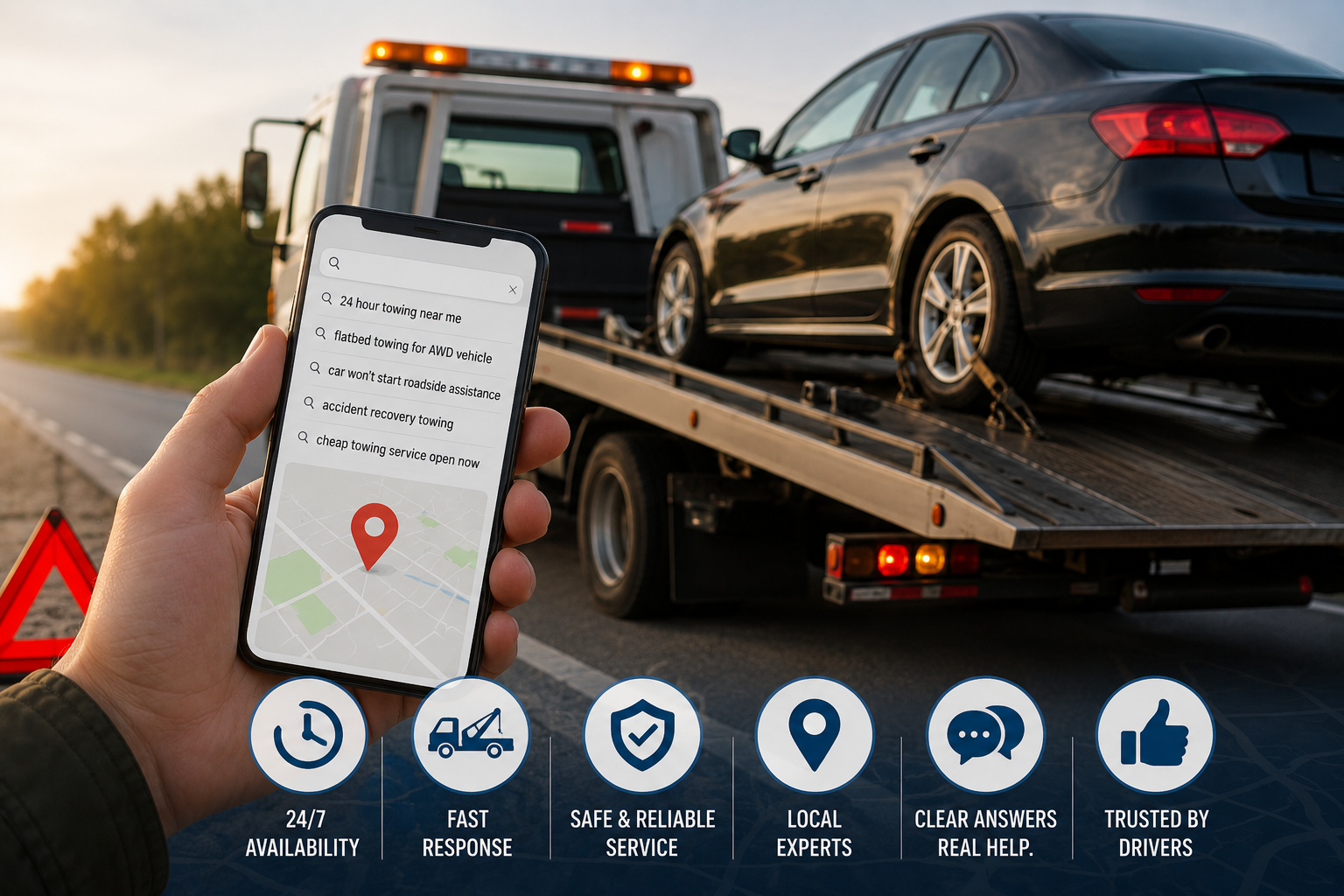
When drivers need towing help, they rarely search using only a city name. Their situation usually comes first: a dead battery, flat tire, locked vehicle, accident, or car that will not start. This means your towing website needs to answer more than “towing service near me.” It must clearly communicate what you do, where you operate, how quickly customers can get help, and why they should trust your business.
Location-based keywords still matter for local visibility, but relying on them alone can leave important search opportunities untapped. A stronger strategy combines local relevance with service intent, customer questions, topical depth, and useful information.
Consider searches such as:
Each search reflects a different customer need. Two people searching from the same city may require completely different services.
If your website repeatedly targets variations of “towing company in [city]” without addressing these needs, your content may appear repetitive and provide little additional value.
Instead, build pages around real customer problems and services, then connect those pages naturally to the locations you serve.
Your website should demonstrate that your business understands common roadside situations.
Create useful content around services such as:
Each topic gives search engines more context about your expertise while helping potential customers find the specific service they need.
For example, rather than creating five nearly identical pages targeting different cities, develop a comprehensive flatbed towing resource that explains when flatbed equipment is appropriate, which vehicles may benefit from it, and what customers should expect during the service.
Local SEO works best when location signals support useful information instead of replacing it.
A strong location page can explain:
This approach creates genuine local relevance. It also gives AI-powered search systems meaningful information they can use when answering location-specific questions.
Towing customers often have urgent questions before they contact a provider.
Your content can address questions such as:
How much does towing cost?
Explain the factors that can influence pricing, such as distance, vehicle type, service type, time, and recovery complexity.
How quickly can a tow truck arrive?
Avoid promising unrealistic times. Explain that arrival depends on traffic, dispatch availability, distance, and roadside conditions.
Is flatbed towing safer for certain vehicles?
Explain why some vehicles may require or benefit from flatbed transportation.
What should I do while waiting for a tow truck?
Provide practical safety guidance, such as moving to a safe location when possible and using hazard lights when appropriate.
Answering these questions makes your website more useful and demonstrates service knowledge beyond keywords.
Search engines increasingly evaluate the broader context surrounding a business and its services. Your content should therefore cover related concepts rather than repeatedly inserting the same keyword.
For example, a towing website can naturally discuss:
vehicle recovery → towing equipment → roadside emergencies → service areas → response process → customer safety → vehicle transportation
This semantic relationship helps establish a clear topical structure.
A specialized Towing SEO Company can help organize these subjects into a search-focused content strategy while keeping the website useful for real customers.
Before publishing a new location or service page, ask one simple question:
“What does this page provide that another page does not?”
If the answer is only a different city name, the page probably needs more substance.
Give every page a distinct purpose. A service page should explain the service. A location page should establish local relevance. A guide should solve a customer problem. An FAQ should address specific concerns.
This prevents your website from becoming a collection of thin, repetitive pages.
Modern search visibility is not simply about placing keywords in headings. Your content should be easy to understand, factually clear, logically organized, and directly responsive to search intent.
Use descriptive headings, concise answers, relevant internal links, clear service information, and consistent business details. Write naturally rather than forcing exact-match phrases into every sentence.
Measure the performance of your SEO strategy using several signals:
These metrics reveal whether your content is attracting people who actually need towing services—not merely generating impressions for city-based keywords.
Is location-based SEO still important for towing companies?
Yes. Location remains essential because towing is a highly local service. However, it should work alongside service-specific, problem-focused, and informational content.
What keywords should towing companies target besides city names?
Consider service and intent keywords such as emergency towing, flatbed towing, accident recovery, roadside assistance, vehicle recovery, and 24-hour towing. Customer-question keywords can also uncover valuable opportunities.
Should every towing service have its own page?
When the service is genuinely offered and has distinct customer intent, a dedicated page can be useful. Each page should provide unique, helpful information rather than simply changing the location or keyword.
How can a towing website improve its visibility in AI search?
Create authoritative, clearly structured content that directly answers customer questions, explains services accurately, demonstrates local relevance, and provides consistent business information. This gives search systems stronger context about your company and expertise.
What is the biggest mistake with location-based towing SEO?
Creating large numbers of nearly identical location pages without meaningful local or service-specific information. Quality, relevance, and usefulness should come before simply increasing the number of keyword-targeted pages.